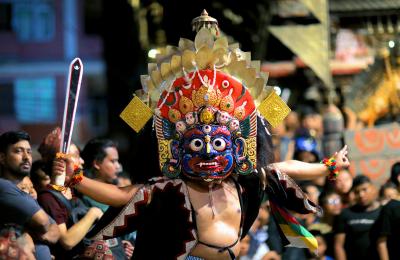
Tihar, also called Deepawali, is Nepal’s five-day Festival of Lights — a celebration that honours crows, dogs, cows and oxen before closing with Laxmi Puja and Bhai Tika, the bond between brothers and sisters. Homes are lit with rows of oil lamps and fairy lights, markets fill with marigold garlands, and streets echo with Deusi-Bhailo singing late into the night. Coming so soon after Dashain, Tihar is gentler and more intimate — a festival of home, family and light rather than large public gatherings. For photographers, it is one of the richest weeks on Nepal’s calendar: warm light, devotional ritual, and street life all at once.
When Is Tihar 2026?
In 2026, the core days of Tihar fall as follows: Laxmi Puja (Gai Tihar) on Sunday, November 8, Govardhan Puja and Mha Puja on Monday, November 9, and Bhai Tika on Tuesday, November 10. By tradition, the festival opens two days earlier with Kaag Tihar (crow worship) and Kukur Tihar (dog worship), so the full five-day celebration runs from roughly November 6 through November 10.
The Five Days of Tihar
1. Kaag Tihar — Honouring the Crow
The festival opens with offerings to crows, messengers of Yamaraj, the god of death, placed on rooftops and in courtyards at dawn — a quiet, contemplative start to a festival that grows louder each day.
2. Kukur Tihar — Honouring the Dog
Dogs are garlanded with marigolds, marked with tika, and fed first — a tribute to loyalty that is unique to Nepal among South Asian festivals. In Kathmandu, Nepal Police dog units are often publicly honoured on this day, a popular subject for photojournalists and street photographers alike.

3. Laxmi Puja (Gai Tihar) — Light, Prosperity, and the Cow
The third day is Tihar’s visual centrepiece. Cows are worshipped in the morning, and by evening every home lights rows of diyo (oil lamps), candles and strings of lights to welcome Laxmi, the goddess of wealth. Courtyards are decorated with marigold and globe amaranth (makhmali) garlands, and rangoli-style patterns mark doorways.

In Bhaktapur, many of the clay lamps lit that night are still hand-shaped by local potters in the days beforehand — a craft worth photographing in its own right.
4. Govardhan Puja and Mha Puja
The fourth day honours oxen and, in some traditions, Govardhan Hill; for Newar communities it is also Mha Puja, a ritual of self-worship, and marks the start of the Nepal Sambat New Year.

5. Bhai Tika — The Festival’s Heart
The final day belongs to brothers and sisters. Sisters apply a multicoloured seven-ring tika to their brothers’ foreheads, exchange garlands and gifts, and share a festive meal — a ritual believed to protect brothers from Yamaraj himself. It is the most emotionally rich, and most photographed, moment of Tihar.

Tihar Food: Sel Roti and Festive Treats
No Tihar celebration is complete without sel roti, a ring-shaped, slightly sweet rice-flour doughnut fried fresh in homes throughout the festival. Alongside it, households prepare an array of sweets and snacks for visiting family, Deusi-Bhailo performers, and Bhai Tika guests — the kitchen, piled with marigolds and frying sel roti, is itself one of Tihar’s most photogenic, least-covered scenes.
Deusi-Bhailo: Nepal’s Festival Street Music
Through the lit-up evenings of Tihar, groups of children and adults go door to door performing Deusi (for boys/men) and Bhailo (for girls/women) — folk songs and dance performed in exchange for blessings, sweets or money. It is one of the most joyful, candid-photography-friendly traditions in Nepal, especially in Kathmandu’s old neighbourhoods and Bhaktapur’s courtyards.

Best Places in Nepal to Photograph Tihar
- Kathmandu Durbar Square and the old city markets — marigold garland stalls, diyo and candle sellers, and lit storefronts make for Nepal’s busiest Tihar street photography.
- Bhaktapur Durbar Square — traditional clay-lamp lighting, Newar rituals, and some of the best-preserved courtyards for low-light photography.
- Patan (Lalitpur) — quieter than Kathmandu, with richly decorated Newar homes during Mha Puja.
- Residential neighbourhoods at dusk — the simplest and often most rewarding setting: doorways and balconies lit with diyo and fairy lights as families finish decorating.

Photography Tips for Tihar Night Scenes
- Shoot at blue hour, not full dark. The 20–30 minutes after sunset balance the sky with the warmth of diyo and string lights far better than a fully black sky.
- Bring a small tripod or stabilise against a ledge. Lamp-lit scenes mean slow shutter speeds; a tripod keeps the warm, grainless look that makes Tihar images stand out.
- Shoot wide for scene, close for detail. A wide frame captures a lit courtyard or market; a macro or close-up shot of a single hand-painted diyo or a tika-marked forehead often tells the stronger story.
- Ask before photographing rituals. Bhai Tika and Mha Puja are family and devotional moments. A nod and a smile go a long way, and the resulting portraits are warmer for it.
License Real Tihar Photography from Image Pasal
Every photo in this guide was taken in Nepal by a Nepali photographer and is available to license on Image Pasal in Small, Medium and Large resolutions — no stock-photo clichés, no AI generation, just real festivals as they happened. Browse the full Tihar photo collection, or explore more Nepali culture and festival photography.
If you photographed this year’s Tihar yourself, Image Pasal’s photographer marketplace lets you upload and sell your own festival photos directly to buyers worldwide.
Frequently Asked Questions
When is Tihar 2026 in Nepal?
Laxmi Puja falls on November 8, Govardhan Puja and Mha Puja on November 9, and Bhai Tika on November 10, 2026, with Kaag Tihar and Kukur Tihar in the two days before.
What is Kukur Tihar?
The second day of Tihar, when dogs are garlanded, marked with tika and given a special meal in recognition of their loyalty and companionship.
Can I use Image Pasal’s Tihar photos for commercial projects?
Yes — photos marked Creative carry a royalty-free licence for commercial use such as websites, advertising and print. Photos marked Editorial are for news, education and commentary only. See the licence terms for details.
Looking for more Nepali festivals? Read our guide to Dashain Festival in Nepal, the celebration that precedes Tihar every year.